The Ultimate Guide to Automotive CRM For Winning More Sales
Automotive CRM guide for dealerships. Learn features, benefits, mistakes to avoid, and how CRM boosts sales, service, and customer retention.
Contact Us
Automotive CRM is customer relationship management software built for car dealerships, OEM showrooms, and auto service centers. It brings sales, service, and marketing data into one customer record: inquiries, vehicle preferences, test drive bookings, finance status, and service history. With that record in place, your team tracks every lead, schedules follow ups on time, and manages the full automotive customer lifecycle from the first inquiry to the next trade-in.
Generic CRM tools treat a car sale like any other transaction. CRM software for car dealerships follows how the automobile industry actually sells: short buying windows, high-value deals, and long ownership cycles. Sales teams use it to automate the lead management process, follow ups, and deal closures. Service advisors use it for maintenance reminders, warranty tracking, and aftersales communication. That focus helps both teams respond to buyers faster and more accurately.
What sets automotive CRM apart is its industry workflow and integrations. It connects with your DMS and vehicle inventory, supports finance and insurance (F&I) tools, digitizes documents, triggers service reminders, and suggests accessory upsells and cross sells. Together, these features give dealerships and OEMs one platform shaped around how automotive businesses really operate.
Why Automotive Businesses Need a CRM Today
The auto industry is changing fast. Electric vehicles, digital financing, and connected car technology now shape how people buy and maintain vehicles, and this growth reaches well beyond major cities into Tier 2 and Tier 3 markets. Buyers expect quick answers and personalized offers, and spreadsheets cannot keep up with that journey.
Automotive CRM software organizes every customer touchpoint and gives managers clear insight into the sales pipeline, deal progress, and team productivity. Leaders make informed decisions without adding operational burden.
For a single rooftop or a large dealer group, a CRM built for the automotive industry forms the backbone of a competitive operation. When you pair it with AI-driven workflows, your team engages buyers faster, converts more leads, and builds stronger long-term relationships.
Learn more about: Master CRM Challenges in 2025 to Drive Business Growth
Why Automotive Businesses Can’t Ignore CRM
How Does Automotive CRM Work?
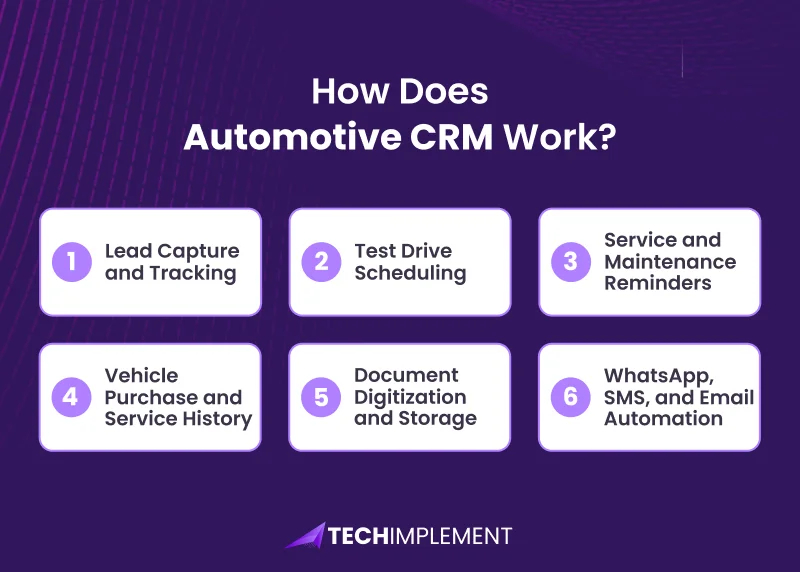
Automotive CRM works as a central hub for sales, service, and marketing teams. It organizes every customer interaction and supports the whole journey, from lead capture to aftersales service. Each team sees the same complete customer view, so they follow up at the right moment, personalize every touchpoint, and deliver a more professional experience.
1. Lead Capture and Tracking
A CRM pulls every incoming lead into one place, whether it arrives from your dealership website, online ads, third-party car portals, or showroom walk-ins. Most portals and OEM programs send leads in ADF (Auto-lead Data Format), and a good automotive CRM reads that format automatically. The system then categorizes each inquiry and routes it to the right sales executive based on location, availability, or model expertise. This structured approach means no inquiry slips through, reps follow up faster, and conversion rates improve.
Key Benefits:
2. Test Drive Scheduling
A smart scheduling module lets dealerships book test drives without back and forth calls or manual tracking. Sales consultants schedule, reschedule, or confirm a drive in seconds while the system checks vehicle availability and open time slots. Customers receive instant confirmations and reminders, and staff get an alert before each appointment. The result is fewer no-shows, zero double bookings, and a ready vehicle and consultant for every buyer.
Key Benefits
3. Service and Maintenance Reminders
Automated reminders keep your service department connected with customers long after the sale. The CRM sends timely alerts for routine servicing, warranty renewals, and insurance updates, each with personalized details so customers know exactly what is due and when. This proactive aftersales management builds trust and positions your dealership as a long-term partner. Customers return to the same service center, and retention and lifetime value rise with every visit.
Key Advantages:
4. Vehicle Purchase and Service History
A CRM records every step of a customer’s vehicle journey: purchase history, service records, past issues, contact details, preferred models, budget, financing eligibility, trade-ins, and test drive requests. This 360 degree profile sits at the core of vehicle relationship management. Sales and service teams use it to offer trade-ins, upgrades, or extended warranties at the right time, based on real behavior instead of guesswork. Because the history lives in the CRM rather than in one salesperson’s phone, the relationship stays with the dealership.
Key Advantages:
5. Document Digitization and Storage
The CRM digitizes and securely stores essential documents such as RC copies, insurance papers, loan approvals, and service invoices. Your team drops manual files, cuts errors, and saves hours every week. Sales and service staff pull up the right document while they assist a customer, which speeds up insurance renewals, loan processing, and service follow ups. Centralized storage also gives you tighter control over data security and compliance.
Key Benefits:
6. WhatsApp, SMS, and Email Automation
A CRM runs all customer communication from one place. WhatsApp automation sends instant replies, test drive confirmations, and timely follow ups. SMS and email campaigns handle promotions, service reminders, and post-sale updates. When one follow up system manages every channel, your team nurtures leads consistently and misses fewer opportunities.
Key Advantages:
How Automotive CRM Drives Success for Dealerships
Automotive CRM brings leads, service bookings, and customer interactions together, so dealerships run leaner operations and build better customer relationships. Here are the real-world benefits and how the software delivers each one.
Faster Lead Conversion
An automotive CRM shortens the sales cycle. It distributes leads from websites, comparison portals, and walk-ins to the right sales consultants based on location, budget, and model interest. Automated email and WhatsApp follow ups then move prospects toward test drives and finance approvals. The investment still pays back: Nucleus Research found that CRM returned $8.71 for every dollar spent in 2014, and the average return settled at $3.10 per dollar by 2023 as CRM became standard practice across industries.
Better Customer Retention
Long-term loyalty in the automotive industry depends on engagement after the sale. A CRM tracks service history, warranty status, and past purchases, so your team can send personalized offers like free check-ups or discounted maintenance. Consistent follow up builds trust, drives repeat servicing and upgrades, and raises customer lifetime value.
Improved Service Center Bookings
Service scheduling modules help workshops fill capacity by managing available slots, technician schedules, and spare parts inventory. Automated reminders keep customers on track with periodic maintenance, which raises service bay utilization and cuts downtime. Service managers earn more revenue per bay and plan resources more accurately.
Automated Insurance and RC Reminders
The CRM tracks each customer’s insurance, registration, and warranty dates and sends renewal reminders through SMS, email, or WhatsApp. Customers renew on time, trust the dealership more, and often buy insurance and extended warranty add-ons along the way.
Efficient Inventory Management
Real-time inventory integration lets sales teams check availability, reserve a vehicle for a buyer, and update stock the moment a deal closes. Dealerships avoid order delays, stop overselling popular models, and allocate stock efficiently across variants.
Higher Upselling and Cross-Selling Rates
When your team analyzes a customer’s vehicle history, financing details, and service patterns, it can recommend the right upgrades, accessories, or extended warranties at the right moment. These CRM insights raise revenue per customer and lower the cost of acquiring new buyers.
Practical Use Cases for Marketing, Sales & Service Teams
Marketing Teams
Marketing teams mine customer data such as vehicle model, purchase cycle, and service habits to build targeted campaigns. Automated SMS, WhatsApp, and email messages promote trade-in offers, accessories, and seasonal service packages to the right owners at the right time. Because sales, service, and marketing share one platform, automotive CRM marketing stays aligned with what each customer actually needs, which lifts engagement, revenue, and overall customer experience.
Sales Teams
Sales teams use Automotive CRM to capture and organize leads from websites, OEM programs, walk-ins, and ads, so no opportunity slips away. The system manages test drive bookings, follow-up reminders, and quotation approvals, which removes delays and keeps prospects engaged. With purchase intent data and past conversations on screen, consultants explain features in plain language, recommend the right vehicle, and close deals faster in competitive segments like SUVs and EVs.
Service Teams
An automotive service CRM keeps workshops organized and proactive. It stores complete service histories, tracks warranties, and sends automated maintenance reminders. Service advisors also schedule insurance renewals and extended warranty offers directly from the system. Customers come back for repeat appointments, bay utilization climbs, and technicians deliver timely service every time.
Choosing the Right Automotive CRM for Your Dealership
The right automotive CRM does more than tick feature boxes. It supports daily operations, team collaboration, and long-term growth. Weigh these factors before you commit:
Best CRM Software Options for the Automotive Industry
These platforms help dealerships manage leads, customer relationships, and the sales pipeline more effectively.
Step-by-Step Guide to Implementing Automotive CRM
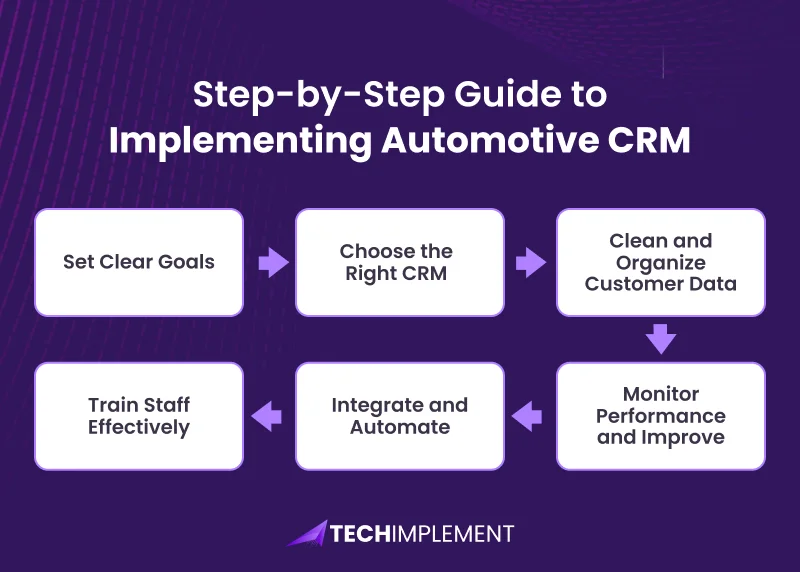
1. Set Clear Goals
Start with measurable objectives. Sales managers might target faster lead response times or better test drive to sale conversions. Service teams might aim for more repeat bookings or automated warranty reminders. Clear targets keep your automotive CRM strategy focused on real results, so the system never turns into an unused tool.
2. Choose the Right CRM
Pick a platform that fits your resources and needs. SaaS CRMs suit dealerships with small IT teams, because the vendor handles hosting, updates, and security. Larger dealer groups often prefer configurable enterprise platforms for deeper customization, such as loan workflows or custom service modules. Automotive templates speed up setup, and a cloud rollout often goes live in weeks, while a DMS-integrated enterprise project can take several months.
3. Clean and Organize Customer Data
Before launch, consolidate and standardize customer records, including vehicle purchases, service history, loan details, and insurance information. Even basic spreadsheets need cleanup. Accurate data powers personalized communication and reliable reporting from day one.
4. Train Staff Effectively
Staff adoption decides success. Run role-based automotive CRM training: sales teams practice lead updates and follow-ups, while service advisors learn warranty tracking and reminders. If you cannot train internally, choose a vendor with onboarding support or guided learning modules.
5. Integrate and Automate
Connect your CRM with your Dealer Management System, inventory tools, and payment platforms for real-time updates. Then automate routine work like insurance renewals and service reminders. SMS and WhatsApp notifications make sure no lead or service reminder ever slips through.
6. Monitor Performance and Improve
Track lead response times, conversion rates, service bookings, and upsells on your dashboards. Smaller dealerships can begin with basic reports, while larger groups break analytics down by vehicle model and campaign ROI. Use these insights to refine sales scripts, service offers, and marketing plans.
Common Mistakes to Avoid with Automotive CRM
Failing to Customize for Dealership Operations
Many dealerships run on standard CRM templates that do not match their real workflows. Without customization, lead qualification, test drive scheduling, RC and insurance tracking, and service lifecycle management all slow down. When you tailor modules for sales, service, and finance teams, adoption improves and data stays accurate. You can see the same principle in how a CRM for financial advisors adapts to industry workflows.
Rushing Advanced Features
Complex features introduced too early confuse staff and slow daily work. Start with the essentials: lead tracking, follow-up automation, and service reminders. Add inventory management or advanced analytics once the team feels comfortable.
Overlooking Mobile Access
Sales and service staff often work away from a desk. A CRM without mobile access or offline syncing blocks real-time updates on leads, bookings, and service follow-ups. Give your team a mobile-friendly platform from the start.
Weak Post-Sale Engagement
When contact stops after the sale, repeat business drops. Use the CRM to schedule warranty notifications, renewal reminders, and personalized service offers. Structured follow-ups strengthen long-term customer relationships, bring owners back for their next vehicle, and generate referrals.
FAQs About Automotive CRM

A CRM in the automotive industry manages all customer information, including purchase history, financing options, service appointments, communication preferences, and upgrade interests. It ensures every interaction is informed and relevant, even though it doesn’t physically reside in the vehicle.
The Tech Implement automotive CRM solution is widely used by large dealer networks and OEMs. Its strong integration, lead management, and automation features make it ideal for tracking leads, managing workflows, and improving customer engagement.
Yes. Two-wheeler dealers can track walk-in leads, schedule test rides, manage service bookings, and send reminders for insurance or maintenance, helping build loyalty in a competitive market.
Absolutely. CRM captures leads from multiple sources, prioritizes hot prospects, and automates timely follow-ups, which boosts test-drive bookings, improves lead conversion, and directly increases vehicle sales.
Most modern CRMs are user-friendly. A few basic training sessions are enough for sales and service teams, and vendors provide onboarding support and tutorials for smooth adoption.
Reputable CRM platforms protect customer data with encryption, role-based access, and regular backups. Many comply with GDPR and local IT laws to maintain privacy and security standards.
Dealerships typically notice faster lead responses and better service bookings within two to three months when the CRM is used consistently and workflows are properly configured.